

Workshops
abroad
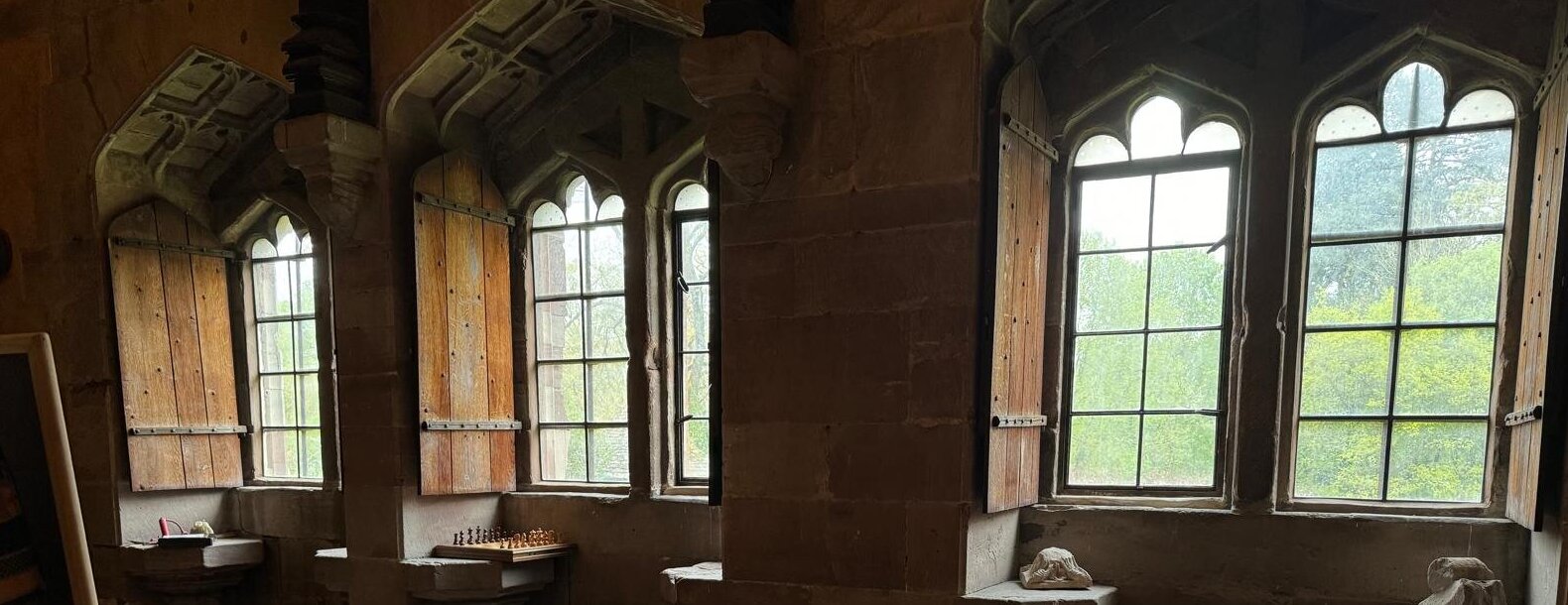
Workshops for the Louis de Wet Foundation in Much Wenlock
In 2023, I was invited by the Louis de Wet Foundation to run workshops in the small English village of Much Wenlock. In the Middle Ages, a thriving Benedictine abbey operated on this site. Following its dissolution by Henry VIII, the monastery buildings fell into ruin. Fortunately, the building that served as the prior’s residence and infirmary, as well as part of the guest house, survived, as these were fairly quickly occupied by private owners. In the 18th century, the buildings were abandoned and also began to deteriorate gradually. In the mid-19th century, new owners took over, and it was from them that Louis and Gabrielle de Wet purchased the property in 1983. Louis de Wet, an artist and philosopher, combined the conservation of the preserved, valuable architectural elements with his own creative work. Together with his wife, they restored the site to its former glory. Following her husband’s death, Gabrielle de Wet continues the effort to maintain such a valuable historic site, also organising various workshops and cultural events on the premises. The venue is ideal for workshops on medieval calligraphy and illumination. It forms part of a former Benedictine monastery, where scriptoria traditionally operated, and retains much of its authentic medieval structure, meaning that classes take place beneath the original wooden ceiling dating from 1425!!! The whole complex – the house, the garden and the monastery ruins next door – creates the unique atmosphere of this place, combined with the hosts’ extraordinary hospitality. The following workshops have taken place so far: 4–6 August 2023: Uncial script workshop 3–5 May 2024: Calligraphy workshop: Carolingian minuscule 27–29 September 2024: Illumination workshop: Initials from the Cluny Bible 16–18 May 2025: illumination workshop: portrait of a scribe This year, the fifth edition of the workshops will take place from 31 July to 3 August. Workshop theme: zodiac signs You can follow the workshop programme on the foundation’s website: https://www.ldw-foundation.com/courses/ And on Facebook
more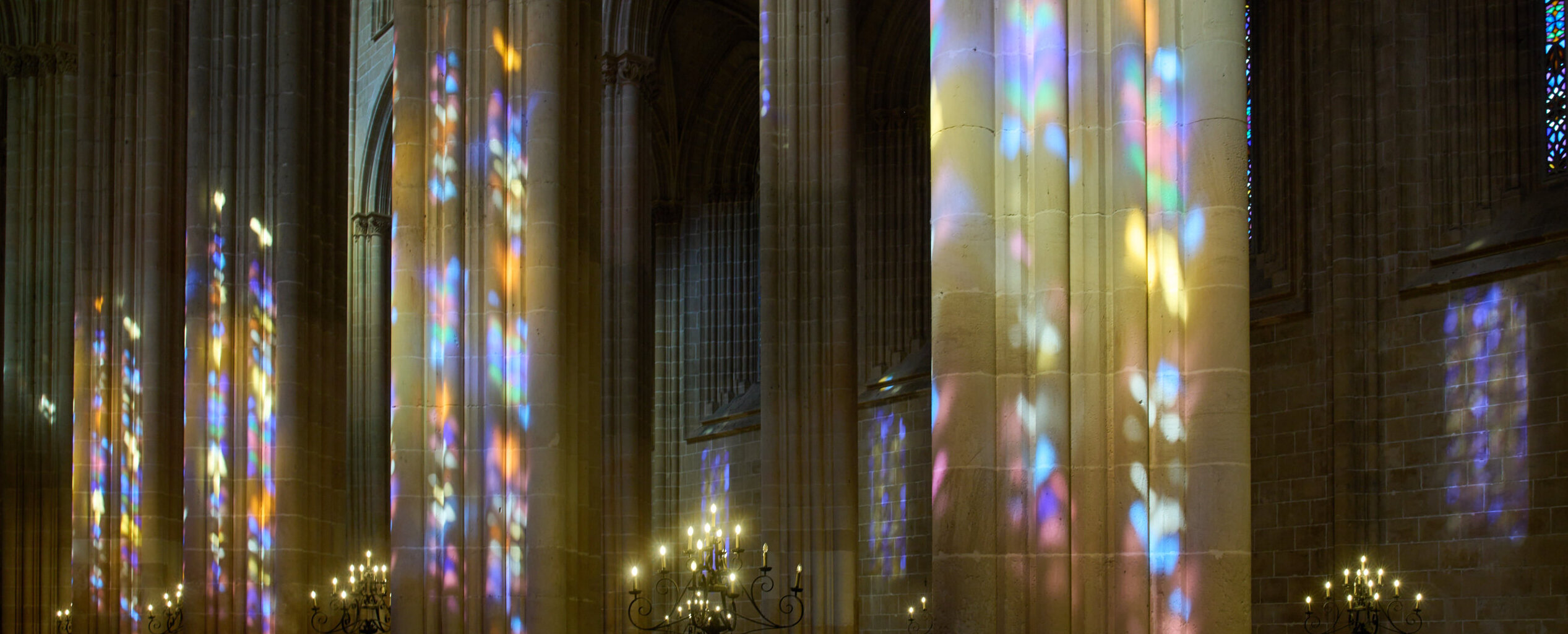
WORKSHOPS IN PORTUGAL – Batalha Monastery
Workshops were held on two occasions at one of the jewels of Gothic architecture in Portugal, namely the former Monastery of Our Lady of Victory in Batalha, which is now a UNESCO World Heritage Site. Batalha means ‘battle’ in Portuguese, and the name of this small town derives from one of the most significant battles in Portuguese history, which took place in the area. The military clash between the Portuguese forces of King John I the Great and the army of John I of Castile took place on 14 August 1385 near the village of Aljubarrota. John I the Great (or the Good) proved to be an excellent commander, whose strategic talent enabled victory over a numerically superior enemy army, ending the interregnum and securing Portugal’s independence from Castile. To commemorate this spectacular victory over Castile in 1385, King John I the Good commissioned the construction of the magnificent Monastery of Santa Maria da Vitória and founded the village of Batalha. Construction began in 1385. It lasted nearly 150 years, with successive rulers contributing to the monastery’s expansion. In 1388, the monastery was handed over to the Dominicans, who managed it until the dissolution of religious orders in 1834. The monastery is considered a prime example of the fusion of English Gothic architecture and elements of the Manueline style. The Battle of Aljubarrota plays a similar role in Portuguese history to our Battle of Grunwald (with the difference that the former battle had actual political significance), which is why Batalha features on every school trip itinerary and is a popular tourist destination, both for its history and the beauty of its architecture. During the workshops, we had the opportunity to explore the monastery in detail – the impressive church housing the largest collection of preserved medieval stained-glass windows in Portugal, the Founders’ Chapel with its royal tombs, including that of Henry the Navigator, the unfinished chapel – the Pantheon of Edward I – and the Royal Cloisters. However, a particularly special experience was holding the workshops in the Cloisters of Alfonso V. Every day, in a quiet corridor with a beautiful view, out in the open air, we were able to devote ourselves to the precise art of illumination. In 2023, the theme was battle scenes, and in 2025, maps.
more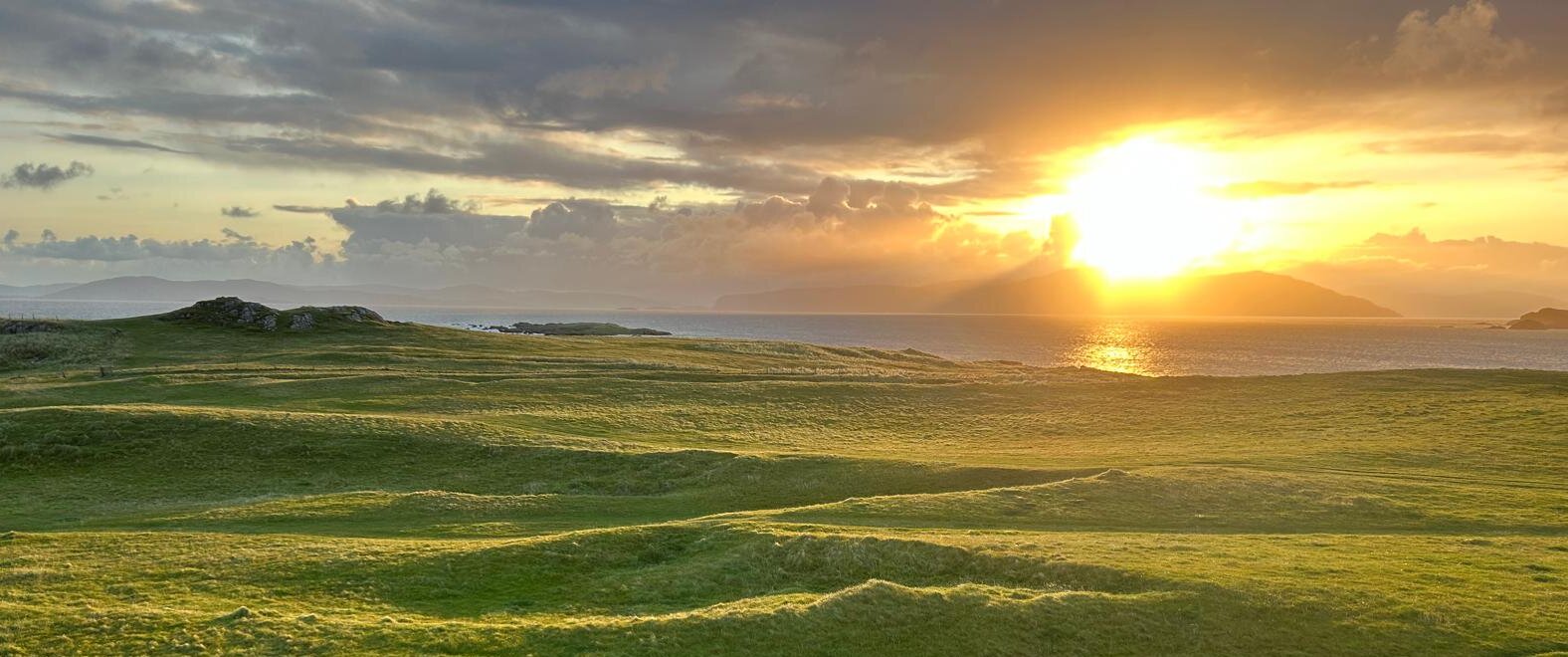
WORKSHOPS IN SCOTLAND ON THE IONA ISLE
One of the most unique places we were able to visit with our travelling Scriptorium was Iona, a small island off the coast of Mull, on the west coast of Scotland, home to a famous monastery. It was one of the oldest and most important Christian religious centres in Western Europe. Founded on the island, it was the first of 53 monasteries established in subsequent years on the initiative of St Columba. The monastery was founded in 563, when Columba and his companions sailed to the island from Ireland. A scriptorium had been in operation there since at least the 8th century, where, among other works, the famous, magnificently decorated Book of Kells was produced, and where the local annals were kept (the original has been lost, but the section from the 7th/8th century was incorporated into the Annals of Ulster). Towards the end of the 7th century, Abbot Adomnán served at the monastery; he left behind a hagiography of St Columbanus, as well as a book describing holy sites in the Middle East. In the 7th and 8th centuries, the monastery’s prestige grew to such an extent that at least two Irish rulers, Niall Frossach (King of Tara, who died in 778) and Artgal (King of Connacht, who died in 791), decided to spend their final years as monks in the community on Iona. Towards the end of the 8th century, the monastery’s peaceful development was threatened by raids from Norwegian Vikings, lured by the easy pickings and rich spoils found in the coastal churches and monasteries. Iona suffered plunder and destruction in 795, 802, 806 and 825, and again in the 10th century. Despite this, the monastery survived mainly thanks to the partial flight of the monks to Kells in Ireland, where land was purchased in 804 and a branch of the monastery was established by 814. The surviving valuables were moved there, and it was there that the abbots resided for a long time and where the monks from Iona took refuge in times of danger. Today, an ecumenical community operates on Iona, on the site of the former monastery. The island is just 1.5 miles long and 3 miles wide, and is visited by 130,000 tourists every year – 1,083 times more than its population (Iona has 120 inhabitants). For this reason, holding workshops in such a unique place is not only a way to connect with the fascinating history of the site, but also a wonderful opportunity to unwind and relax – walks along the coast, chats over a cup of tea, and even a knitting circle. So far, three workshops have taken place on Iona, and we hope to be able to visit again in the future.
more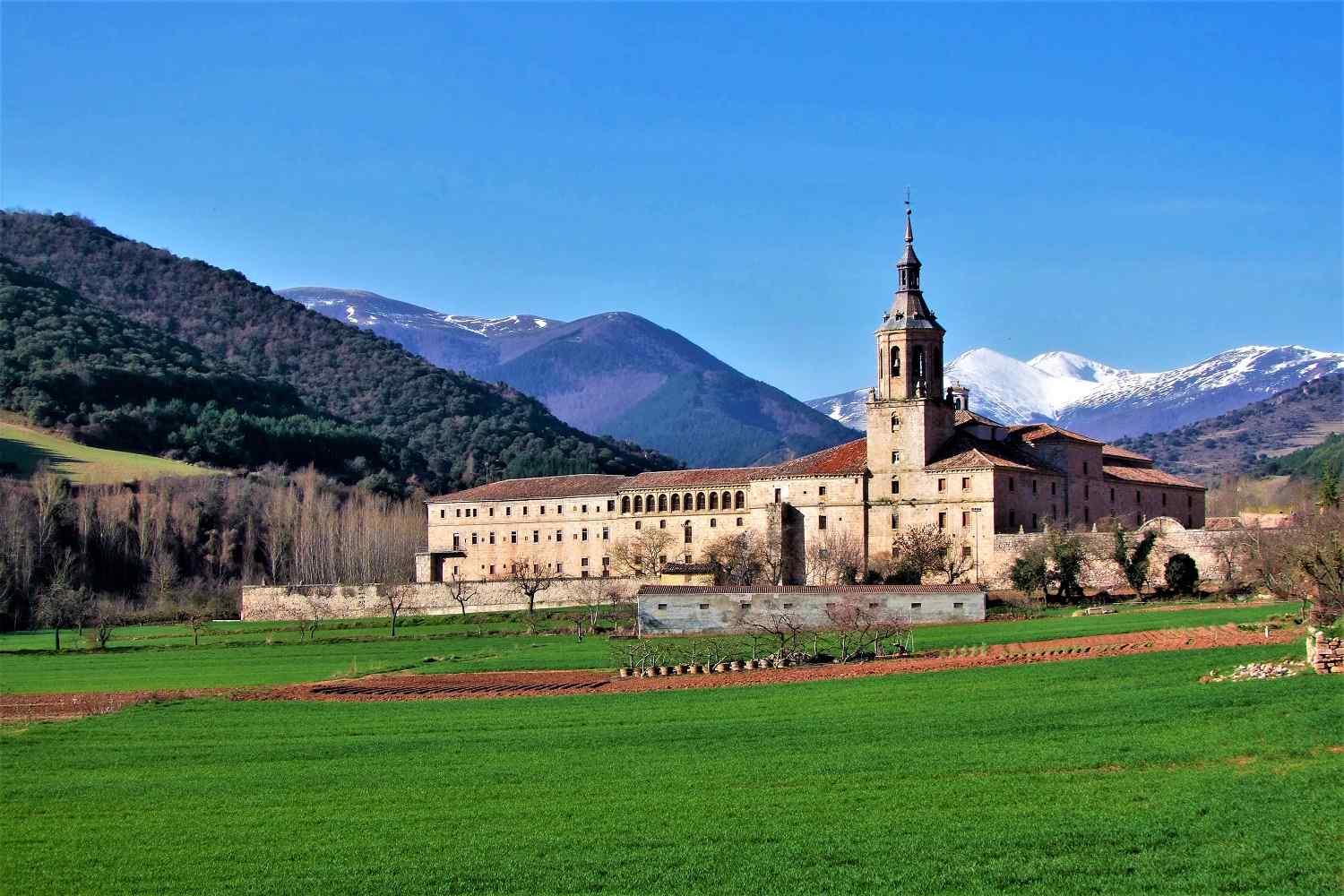
WORKSHOPS IN SPAIN – the monasteries of Suso and Yuso
Workshops held in monasteries always have a special character, but the greater the role a particular place has played in the history of literature, the more we feel the thread connecting us to the past. That is why I found it particularly exciting to be invited to lead a workshop at San Millán de la Cogolla in Spain, home to two twin monasteries: Suso (the upper monastery) dating from the 6th century and Yuso (the lower monastery) from the 11th century. Both were inscribed on the UNESCO World Heritage List in 1997. The cenobium of the ancient monastery of Suso dates back to the Visigothic period and was built in 550, making it one of the oldest in Spain. According to tradition, the monastery was founded on the site of the hermitage of St Emilian (San Millán). In the 10th century, it was inhabited by Mozarabic monks, and the horseshoe arch on the entrance gate and the chapels date from this period. Importantly for us, the Suso monastery witnessed the first Castilian words, as well as the first poems in that language. In 964, the first encyclopaedic dictionary on the Iberian Peninsula was compiled: the Codex Emilianense 46 – alongside the Latin text, glosses were added in the medieval versions of Castilian and Basque. In the 13th century, Gonzalo de Berceo wrote the first poems in Spanish (he was buried in the Romanesque chapel). In the UNESCO description, the monastery is even referred to as ‘the birthplace of the written and spoken modern Spanish language’. The monastery and scriptorium continued to operate even during the Muslim period. In the 11th century, Benedictine monks settled here. In 1503, King García Sánchez of Nájera commissioned the construction of the Yuso Monastery below Suso, to which the monks moved and which remains in use to this day. According to one tradition, the oxen pulling the cart carrying the remains of St Emilian, which the king wished to transfer to the monastery of Santa María la Real, stopped at a certain spot and refused to move on; for this reason, the king decided to build a new monastery at that very spot. Most of the buildings date from the 16th to the 18th centuries. We were able to enhance our workshop with a visit to the library, which is one of the most important in the country, not only in terms of the number of documents it holds, but also their value and age (including around 300 documents dating from the 11th to the 15th centuries). The monastery stood uninhabited for a time in the 19th century, but the monks eventually returned – this time Augustinians, who still live there today. Part of the monastery has been converted into a hotel, and the site is also home to the CILENGUA Centre for Spanish Language Studies. Today, the monastery attracts pilgrims on their way to Santiago de Compostela, although it lies somewhat off the official route from Nájera to Burgos. An interesting addition to the workshop programme was exploring the La Rioja region, which is famous above all for its wine. This region of Spain is home to around 500 vineyards of international renown for the quality of their wine.
more