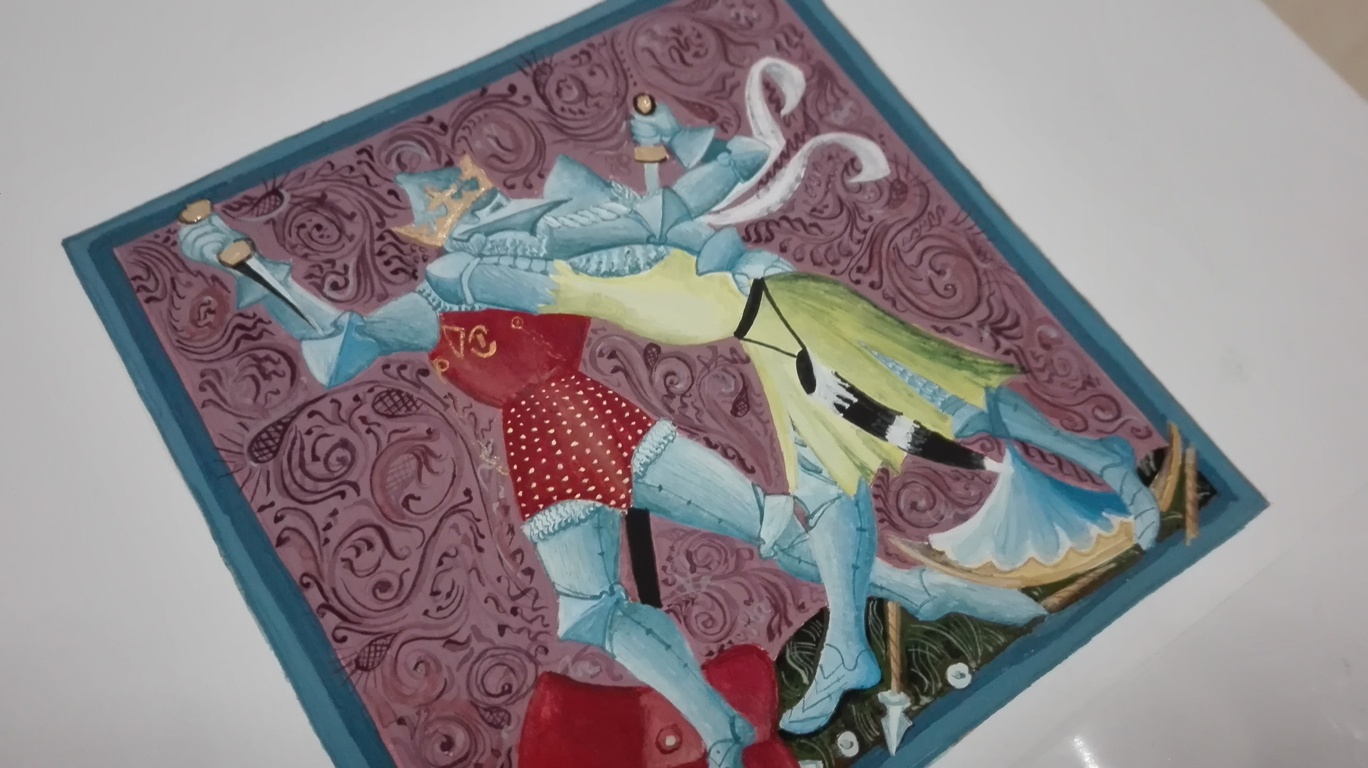

“LADIES AND KNIGHTS” exhibition of medieval miniatures
Another collective exhibition of copies of medieval miniatures was born out of a passion for manuscript books.
I have been running numerous workshops on medieval manuscript painting for many years. Through this, the beauty of miniatures and the precise craftsmanship of book painting is gaining more and more admirers. Painting together gave rise to the idea of an exhibition that is the second collective exhibition of manuscript enthusiasts, after the Bizarre Garden.
The exhibition shows copies of miniatures related to knightly themes. Knighthood played an extremely important role in the diverse medieval society. The knight’s chief duty was to serve in his master’s army. In many miniatures, we find depictions of fighting knights.
They come from various colourful stories of knights that enjoyed great popularity in the Middle Ages , such as The Romance of Alexander—a collection of legends dedicated to Alexander the Great, and Le Roman de la Rose—an allegorical French poem about a young man looking for his beloved rose in the garden of love.
One of the bestsellers was undoubtedly the story of Lancelot du Lac and other stories related to the Knights of the Round Table. Fighting knights are also depicted in the illuminations of treatises from knights’ battles, which discussed the rules and regulations of tournaments. Examples of such works include the famous Tournament book of King René d’Anjou or the manual of war art entitle Bellifortis, by Konrad Kyeser.
Scenes where knights appear can also be found in sacred manuscripts. The best example of this is the so-called Maciejowski Bible (also known as the Morgan Bible) from the 13th century. This is entirely illustrated with full-page miniatures on which biblical figures are depicted in costumes from the period in which the manuscript was written. Details of weapons and knights’ equipment are among the best sources of military science from the Middle Ages.
Of course, the exhibition also included illustrations of historical, chronicle and encyclopaedic works, such as: Speculum Historiale, the Grandes Chroniques de France, or Chronique Universelle by Baldwin of Avesnes. In the Middle Ages, the specific culture and way of life of the feudal and knightly estates developed.
The centre of this is the feudal castle, where the most important events are concentrated. Here, there are feasts and tournaments, and a knight’s ethos is formulated and evolved—that is the set of principles and ideals that should characterize a knight.
One of the virtues of knights becomes the gentlemanly attitude towards women, and its manifestation is the custom suggesting that the knight should fight also for his beloved. That is why the castles and manor houses resonate with romances sung in songs and medieval prose. A beautiful lady whose heart a knight wants to win is a frequent figure in depictions of knights. One of the most famous manuscripts referring to this subject matter is Codex Manesse, a collection of medieval German poetry, represented at this exhibition in several miniatures.
 back
back