
THE EXSULTET SCROLL
One of the most unusual commissions I have received in my career was a request from a cantor for an Exsultet scroll. Medieval Exsultet scrolls are unique liturgical manuscripts that played an important role in the celebration of the Easter Vigil in medieval Europe.
The name ‘Exsultet’ comes from the first word of the Latin hymn Exsultet iam angelica turba caelorum, meaning ‘Rejoice now, angelic choirs of heaven’. This chant is still performed during the Easter Vigil today, though nowadays it is simply a text read from the lectionary.
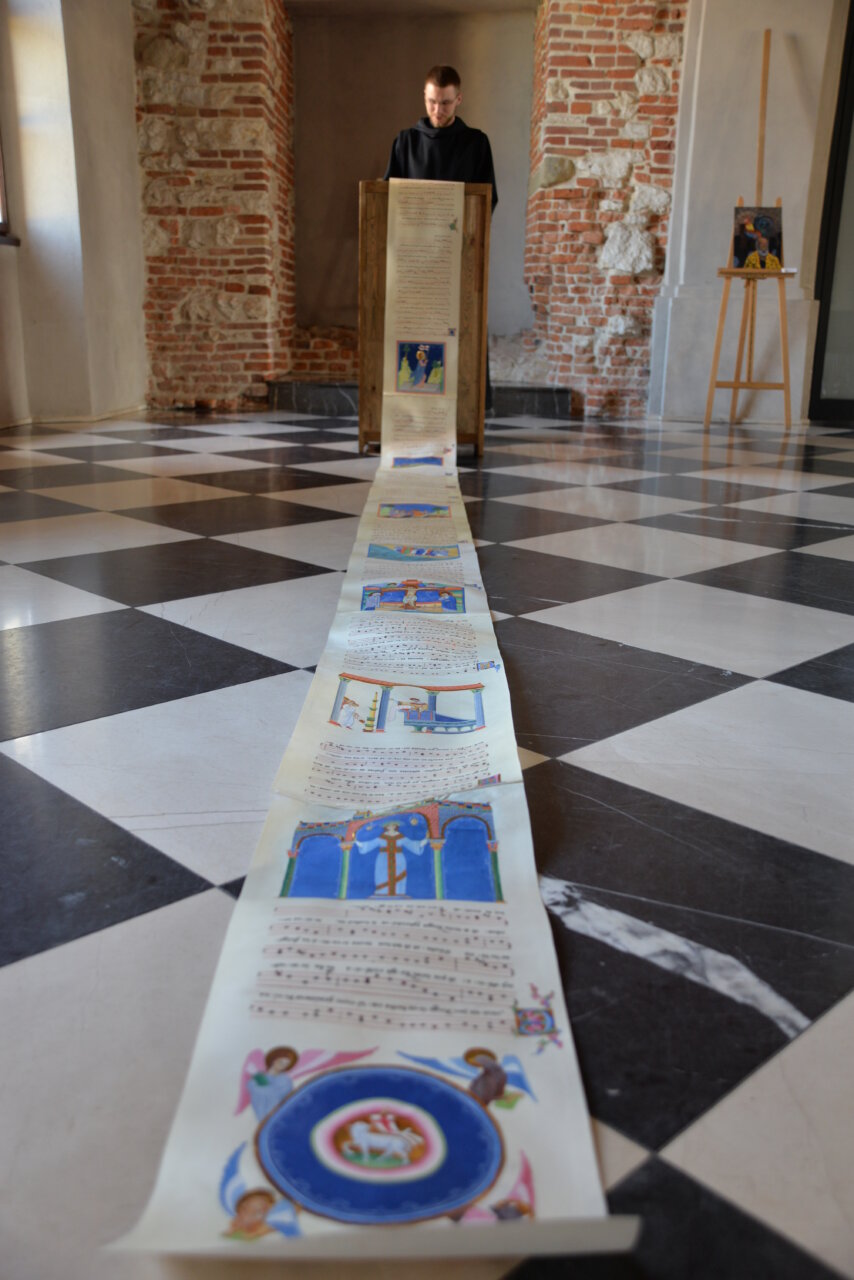
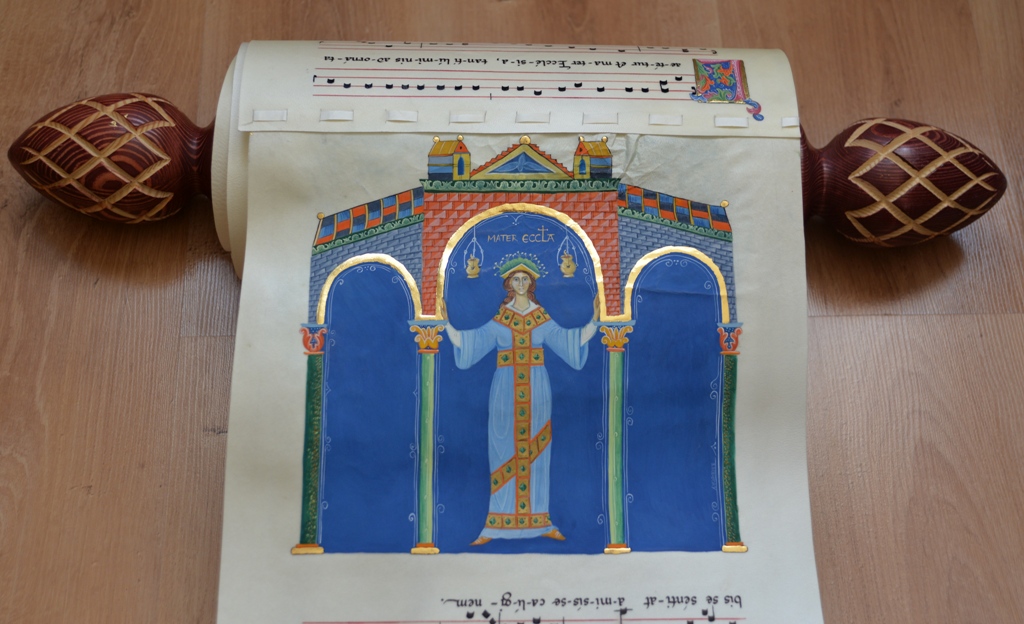
In the Middle Ages, the Exsultet took the form of a long parchment scroll, usually several to over a dozen metres in length. These scrolls were carefully handwritten and often richly illuminated, featuring Passion scenes, symbols of Christ and Easter motifs. The Exsultet scrolls developed certain iconographic patterns. At the beginning, a richly illuminated initial ‘E’ often appeared, followed by an illustration of the Lamb of God, angels, or a depiction of the Maiestas Domini, and an illustration of a cantor singing before the Paschal candle. This might be followed by an illustration of the Church – Ecclesia, the Crucifixion, the Descent into Hell, a miniature with bees, and a final illustration, which was most often the Resurrection.
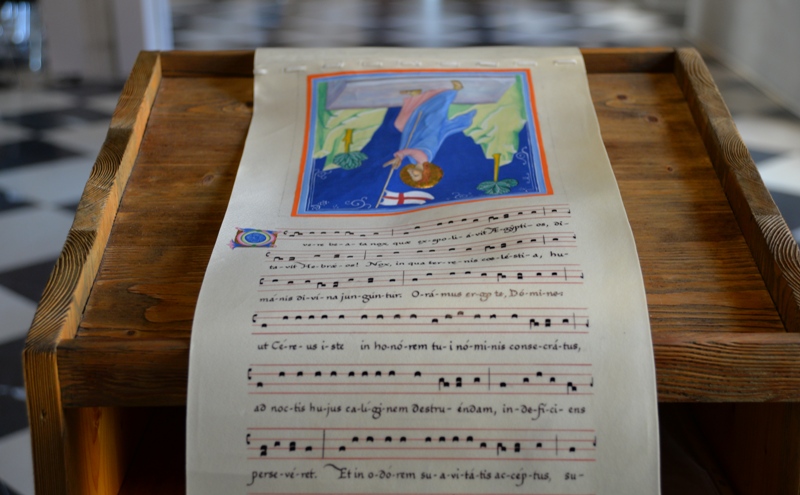
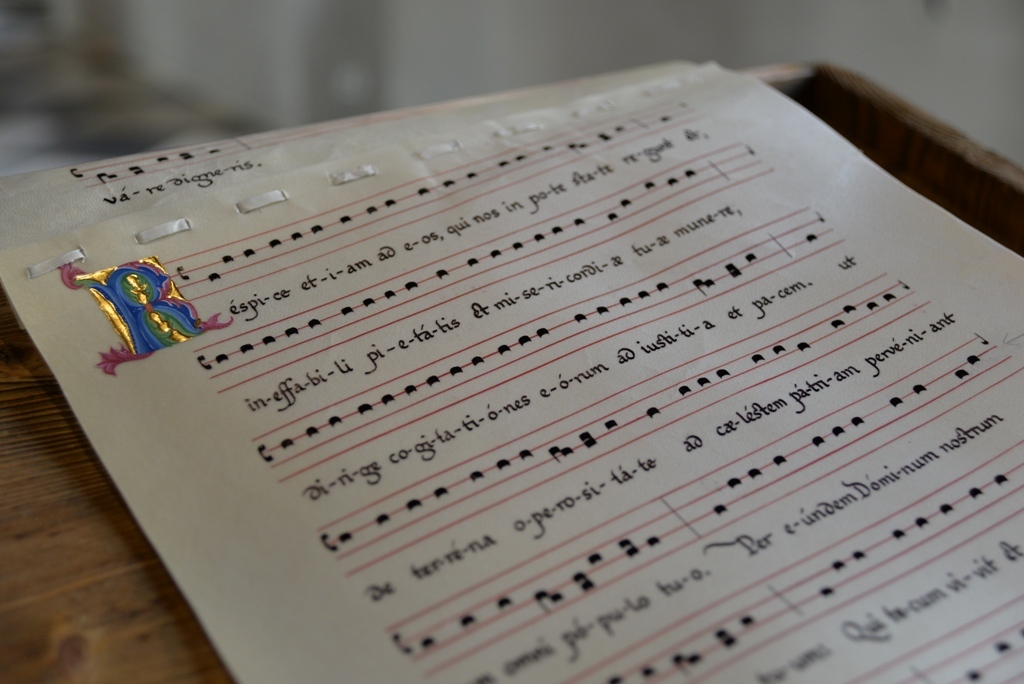
The commission was executed on parchment 35 cm wide and approximately 7 metres long, consisting of eight strips joined together. The work took many months. I created eight miniatures that appear in the text as the scroll is unrolled from the lectern. Of course, for practical reasons, the music and text are written in such a way that the cantor can read them easily. But as the scroll is unrolled, the illustrations that appear are seen upside down by the singer of the Exsultet. This is because the illustrations were intended for the people standing in front of the cantor, not for him.
One such commission appears only once. But who knows, perhaps one day someone will commission another Exsultet scroll.
 back
back