

Projects

Copies of documents for National Museum in Krakow (the Princes Czartoryski Museum)
Production of document reproductions for the Czartoryski Museum as part of the project: ‘Past – Future – Renovation and Fitting-out of the Czartoryski Museum – National Museum in Kraków to Make the Unique Collection Accessible’.
more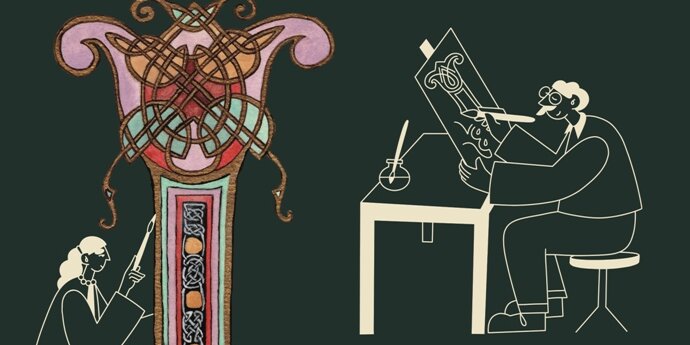
“In the Beginning Was the Initial” – a temporary exhibition at the Tyniec Abbey Museum
Exhibition of facsimiles of pages from illuminated manuscripts at the Tyniec Abbey Museum 2025/2026. The exhibition explores the extraordinary world of medieval and Renaissance manuscripts, which captivated audiences not only with their content but also with their exquisite craftsmanship. Although only a small fraction of them has survived to the present day, the richness of their decoration, and especially their initials, still inspires admiration. Initially, the first letter of a sentence or paragraph, displayed modestly as slightly larger or highlighted in colour, served primarily to organise the layout of the page. Over time, however, the creators of these books gave free rein to their imagination: illuminators began to experiment with form, gradually enlarging the initial and adding various decorative elements. The individual components of the first letter were transformed into freely painted floral, zoomorphic or geometric motifs. The exhibition attempts to showcase the richness and diversity of manuscript decoration over the centuries. On display are life-size copies of entire pages featuring the original painted compositions. This allows visitors not only to see the context in which the initial was placed, but also to appreciate the scribes and illuminators responsible for decorating the codices. Each initial bears the mark of its individual creator, but also the stylistic characteristics of the era in which it was created. No two initials are identical. The manuscripts preserved to this day are the finest testimony to this. The works were created by craftspeople and students associated with Barbara Bodziona’s workshop, where medieval illumination techniques have been passionately recreated for the past 18 years. The exhibition is accompanied by a virtual catalogue, in which you will find a catalogue entry for each manuscript from which the pages are presented, as well as a transcription of the text along with its translation. An initial was always closely linked to the text for which it was designed. Knowledge of the context gives us a full picture and an understanding of its role on the manuscript page, which often goes far beyond mere graphic embellishment of the composition.
more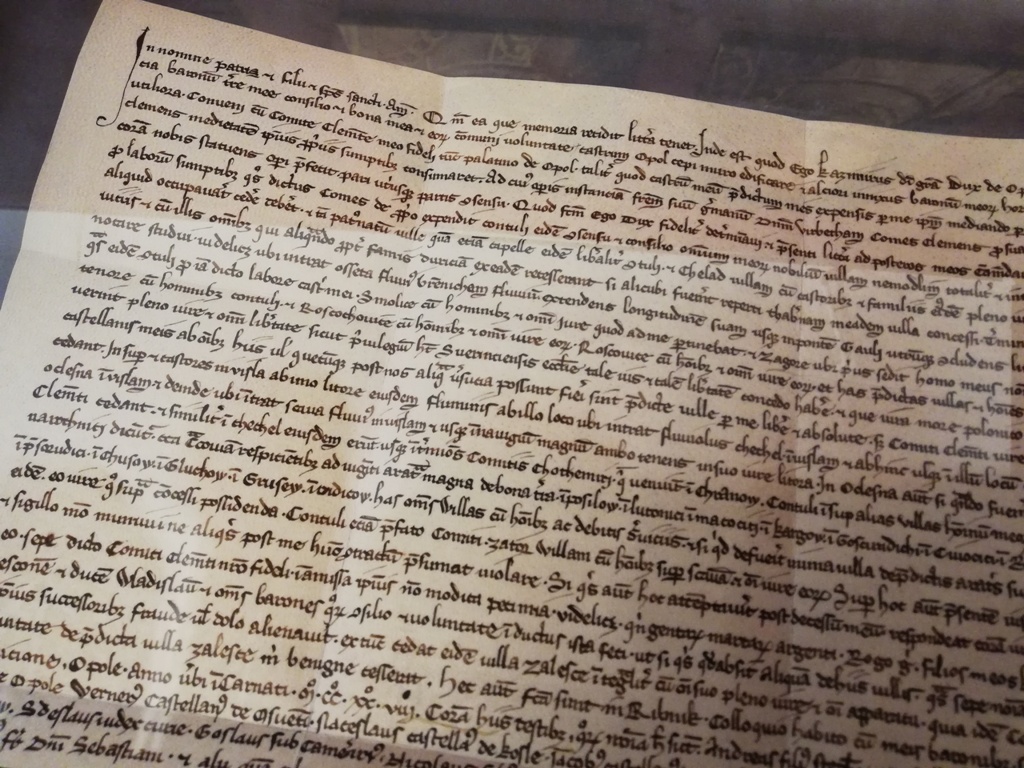
Copies of parchment documents
At the request of various institutions, I have produced several very interesting copies of parchment documents intended for display in museums. Medieval documents that have survived to the present day are extremely valuable and sensitive to fluctuations in humidity, temperature and light. This is why we so rarely have the opportunity to see the originals, usually only at temporary exhibitions. Museums and other institutions sometimes commission hand-made facsimiles, not only to visually replicate the document, but also so that visitors can see a material (usually parchment) similar to the original version. I have completed a few such commissions in my studio. Each was a very interesting project, providing me with many new skills. Between 2018 and 2019, I produced copies of documents for the Czartoryski Museum in Kraków. You can read more about this project here. In 2020, on behalf of the Museum in Chrzanów, I produced a copy of a document from 1228. The original of which is held at the Benedictine convent in Staniątki. In 2021 – commissioned by Chrzanów Waterworks, I produced a copy of a parchment document from the opening of the waterworks in 1935. In 2021 – commissioned by the K. Pułaski Museum in Warka, I produced a copy of a document by King Stefan Batory (1576–1586) from the second half of the 16th century. In 2022 – commissioned by the Museum in Chrzanów, I produced another copy of a document, the original of which is held at the Benedictine convent in Staniątki. This time it was a document from 1243 by Konrad of Mazovia granting the convent in Staniątki the privilege of salt. In 2023, commissioned by the Community Committee for the 800th Anniversary of Rumia, I produced a reconstruction of a document from 1224 issued by Świętopełk, containing the first mention of Rumia. I encourage any institutions interested in having similar copies made to get in touch.
more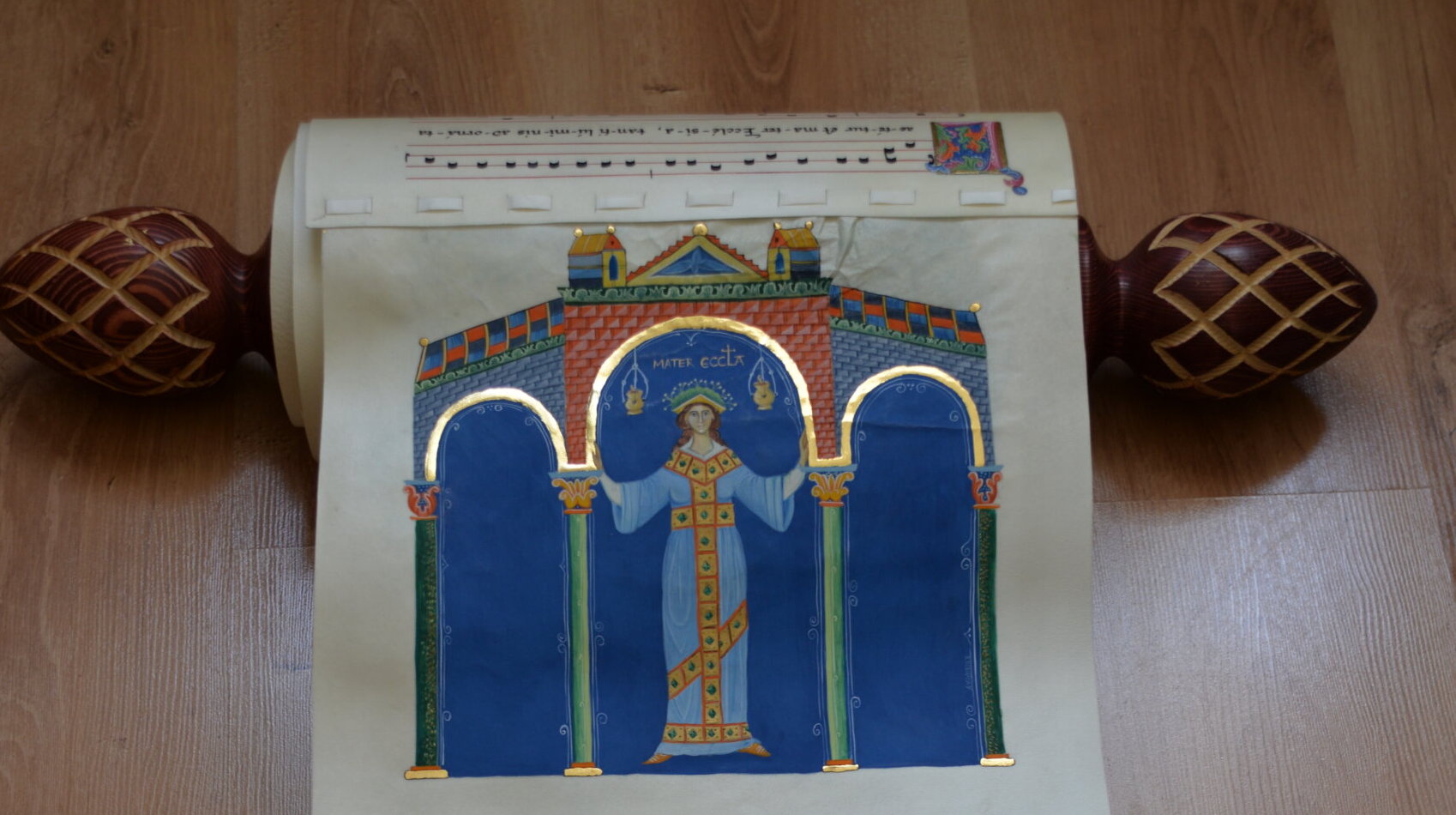
THE EXSULTET SCROLL
One of the most unusual commissions I have received in my career was a request from a cantor for an Exsultet scroll. Medieval Exsultet scrolls are unique liturgical manuscripts that played an important role in the celebration of the Easter Vigil in medieval Europe. The name ‘Exsultet’ comes from the first word of the Latin hymn Exsultet iam angelica turba caelorum, meaning ‘Rejoice now, angelic choirs of heaven’. This chant is still performed during the Easter Vigil today, though nowadays it is simply a text read from the lectionary. In the Middle Ages, the Exsultet took the form of a long parchment scroll, usually several to over a dozen metres in length. These scrolls were carefully handwritten and often richly illuminated, featuring Passion scenes, symbols of Christ and Easter motifs. The Exsultet scrolls developed certain iconographic patterns. At the beginning, a richly illuminated initial ‘E’ often appeared, followed by an illustration of the Lamb of God, angels, or a depiction of the Maiestas Domini, and an illustration of a cantor singing before the Paschal candle. This might be followed by an illustration of the Church – Ecclesia, the Crucifixion, the Descent into Hell, a miniature with bees, and a final illustration, which was most often the Resurrection. The commission was executed on parchment 35 cm wide and approximately 7 metres long, consisting of eight strips joined together. The work took many months. I created eight miniatures that appear in the text as the scroll is unrolled from the lectern. Of course, for practical reasons, the music and text are written in such a way that the cantor can read them easily. But as the scroll is unrolled, the illustrations that appear are seen upside down by the singer of the Exsultet. This is because the illustrations were intended for the people standing in front of the cantor, not for him. One such commission appears only once. But who knows, perhaps one day someone will commission another Exsultet scroll.
more